
The Not So “Silent Years”
When we open the pages of the New Testament, we step into a world already in motion—a world shaped by centuries of history, struggle, faithfulness, and expectation. That world is what scholars call the Second Temple Period, and without understanding it, many parts of Scripture can feel disconnected or confusing. But when we begin to see this period clearly, the teachings of Jesus and the apostles come alive in a deeper and more meaningful way. We often study the theological significance of Jesus, and possibly because of the importance of the deity of Jesus we often think of him as someone who transcends time and culture. While his instructions surely so this, Jesus was a real person and situated himself in time and in a specific culture in the first century. In order to understand him better we must learn to not only understand Jesus from a theological perspective but also a historical and cultural perspective. To do this me must understand the time he lived in, The Second Temple Period.
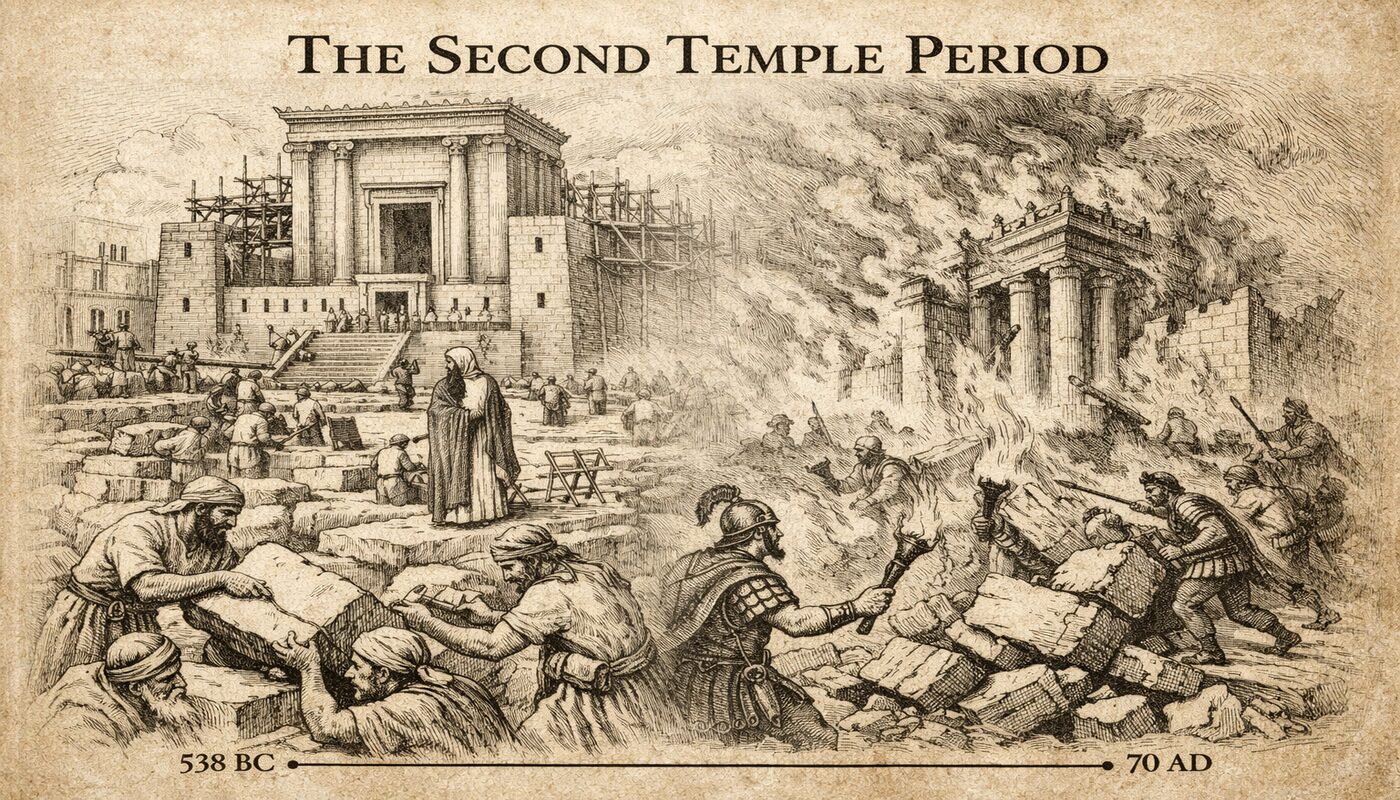
The Second Temple Period spans roughly from 538 BC to 70 AD. It begins when the Jewish people return from exile in Babylon and rebuild the Temple in Jerusalem (Ezra 1–6), and it ends with the destruction of that same Temple by the Romans in 70 AD. This period is essential because it forms the historical and spiritual bridge between the Hebrew Scriptures and the New Testament often called the “Silent Years” in Christian tradition due to the lack of canonized literature during that time. However we will find that those years were anything but silent for God’s people.
The Persian Period (538–332 BC)
The period begins with the decree of Cyrus of Persia allowing the Jewish exiles to return (Ezra 1:1–4). The Temple was rebuilt under Zerubbabel and Joshua the high priest (Ezra 6:14–15), fulfilling prophetic encouragement from Haggai and Zechariah (Haggai 1–2; Zechariah 4).
Ezra and Nehemiah later led reforms centered on Torah observance. Ezra’s public reading of the Law (Nehemiah 8:1–8) reflects the centralization of Scripture in post-exilic Judaism. This period also marks the emergence of “Yehud” (the Persian province of Judah) and the development of scribal authority.
Extra-biblical sources such as Elephantine papyri attest to Jewish communities in Egypt during this time, maintaining Temple-like worship alongside Jerusalem. This era established the foundational structures of Second Temple Judaism, including Torah-centered identity and priestly leadership.
The Early Hellenistic Period (332–198 BC)
Following Alexander the Great’s conquest (ca. 332 BC), Judea came under Greek influence. After his death, control shifted between the Ptolemies (Egypt) and Seleucids (Syria).
During this period, the Hebrew Scriptures were translated into Greek (the Septuagint), traditionally associated with the reign of Ptolemy II (Letter of Aristeas). This translation reflects both the spread of Greek language and the dispersion of Jewish communities.
Jewish literature from this time, including Tobit and Sirach (Ecclesiasticus), reflects ongoing engagement with Torah while navigating Hellenistic culture. Sirach emphasizes Temple worship and priesthood (Sirach 50), demonstrating continuity with earlier traditions.
The Seleucid Crisis and Maccabean Revolt (198–140 BC)
Under Seleucid rule, particularly Antiochus IV Epiphanes, Jewish practices were suppressed. According to 1 Maccabees 1:41–64, circumcision, Sabbath observance, and Torah study were outlawed, and the Temple was desecrated.
This led to the Maccabean Revolt (167 BC), led by Mattathias and his sons. Judas Maccabeus recaptured Jerusalem and rededicated the Temple (1 Maccabees 4:36–59), commemorated in Hanukkah.
2 Maccabees adds theological interpretation, emphasizing martyrdom and resurrection hope (2 Maccabees 7). These texts reflect growing apocalyptic expectations also seen in works like 1 Enoch, where heavenly visions and final judgment themes emerge.
The Hasmonean Kingdom (140–63 BC)
Following the revolt, the Hasmonean dynasty established an independent Jewish state. Leaders such as John Hyrcanus expanded territory and combined kingship with the high priesthood, a development noted by Josephus (Antiquities 13).
This period saw internal tensions over legitimacy and interpretation of the Torah. Groups such as the Pharisees and Sadducees likely emerged or became more defined during this time.
The Dead Sea Scrolls, associated with the Qumran community, reflect sectarian divisions. These texts emphasize strict covenant observance, priestly purity, and eschatological expectation, anticipating divine intervention and restoration.
The Roman Period and Herodian Rule (63 BC – 70 AD)
Rome entered Judea in 63 BC under Pompey. Herod the Great (37–4 BC), a Roman client king, undertook massive building projects, including the expansion of the Temple, described in detail by Josephus (Jewish War 5).
By the first century, Jewish society included diverse groups: Pharisees (Torah-focused teachers), Sadducees (Temple leadership), Essenes (sectarian communities), Zealots (militant group), Hellenistic (Greek oriented), and others. The New Testament reflects this landscape (e.g., Matthew 23; Acts 23:6–8), and it is in this setting that the Nazarenes sect (Acts 24:5) that followed Jesus appeared.
Temple worship remained central. Sacrificial service, priestly duties, and pilgrimage festivals structured Jewish life, as reflected in descriptions of Temple practice .
Apocalyptic expectation intensified during this period. Texts like 1 Enoch and later writings describe heavenly realities, judgment, and the “Son of Man,” themes echoed in the Gospels and Revelation .
The Destruction of the Temple (70 AD)
Tensions with Rome culminated in the Jewish revolt (66–70 AD). The Roman general Titus destroyed Jerusalem and the Temple in 70 AD, an event recorded extensively by Josephus (Jewish War 6).
Rabbinic sources later describe omens preceding the destruction, such as anomalies in Temple rituals (b. Yoma 39b), indicating perceived divine judgment. What is especially striking is that both rabbinic literature and later summaries connect the beginning of these signs to roughly the same time period as the death of Yeshua.
This event marked the end of the Second Temple Period. The loss of the Temple reshaped Jewish life, shifting focus from sacrificial worship to Torah study, prayer, and synagogue life.
Summary: Why is this important?
As we step into the New Testament, all of these developments form the world behind the text. The prominence of the Temple explains why Jesus’s actions there were so significant (Matthew 21:12–13), and why the apostles continued to worship there (Acts 3:1). The rise of groups like the Pharisees and Sadducees helps us understand the debates over Torah, authority, and resurrection (Acts 23:6–8), and situate Jesus’s debates with the Pharisees within an intra-Jewish debate over interpretation like many other Jewish sects were doing at the time, not as trying to start a new religion.
The spread of Greek language through the Septuagint explains how the message of the Scriptures could move quickly among the nations. At the same time, the literature of the period—such as 1 Enoch and other apocalyptic writings—shows that many in Israel were already expecting divine intervention, judgment, and the coming of a Son of Man. Even the daily rhythm of sacrifice, prayer, and discipleship shaped how people understood devotion to God, as disciples learned not only through teaching but by imitating their master in life and practice. When we recognize this world, the New Testament is no longer disconnected or unfamiliar—it becomes a continuation of Israel’s ongoing story, into which Gentile believers have been graciously brought.
Primary Source: James C. VanderKam, An Introduction to Early Judaism (Grand Rapids, MI: Eerdmans, 2001), 1-50.
Leave a Reply
You must be logged in to post a comment.